Leben und arbeiten an Bord eines Forschungsschiffs

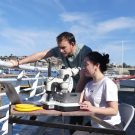
Für mich ist es meine erste Seereise, das erste Mal länger als nur einen Tag auf dem Meer. Und ja, die Labradorsee ist vielleicht nicht unbedingt der einfachste Ort für den Einstieg. Wie viele andere wurde ich in der ersten Nacht ordentlich seekrank. Die starken Bewegungen der Maria S. Merian bei diesen rauen Bedingungen waren […]

MSM142 – Wer sind wir und warum sind wir im Frühling hier?

English version below Für viele Menschen war es schwer zu verstehen, warum man im Frühjahr so weit nach Norden in die Labradorsee reist, um dort Forschung zu betreiben. Das Leben an Bord ist anstrengend und wird durch die harschen und schnell wechselnden Wetterbedingungen zusätzlich erschwert, was besonders den Einsatz unserer Forschungsgeräte kompliziert macht. Worum geht […]

from JellyMeter Blog

The Invisible Invasion: Why Do Some Species Get Attention and Others Don’t?

The freshwater jellyfish Craspedacusta sowerbii is one of the world’s most widespread invasive species, now found across freshwater systems on nearly every continent. Yet most people have never heard of it. Our recent European study revealed that: 🔗 https://besjournals.onlinelibrary.wiley.com/doi/full/10.1002/pan3.70344 This raises an interesting question: How can a species spread globally while remaining almost socially invisible? […]

from Ocean Voices Blog

Ein neuer Blick auf den Ozean – Studierende übernehmen das Wort

English Version below Ringvorlesung “Verantwortung für das Erbe Meer” übernimmt Ocean Voices fürs SoSe 26 Mit dem Start der Ringvorlesung „Verantwortung für das Erbe Meer“  vom Green Office der Christian-Albrechts-Universität zu Kiel bekommt dieser Blog eine neue Perspektive: Im Laufe des Sommersemesters werden hier Beiträge von Studierenden erscheinen, die sich mit den Inhalten der Veranstaltungsreihe […]

Chemie: macht das Unsichtbare sichtbar

English version below Wenn man an Chemie denkt, denkt man wahrscheinlich schnell an explodierende Gläser, ätzende Säuren und verrückte Professoren, aber nicht an den Ozean. Hier an Bord wird unsere Wissenschaftsteam auch von zwei chemischen Ozeanographen begleitet, Tobias Steinhoff und Kristin Kampen. Den beiden habe ich die Frage gestellt, „Was findet ihr an der chemischen […]

Between Storms and Science: Easter in the Labrador Sea (04.04.26–13.04.26)

Between all the scientific work, we celebrated Easter on board, although the weather had other plans for us. Due to rough conditions, we weren’t able to carry out any CTD casts. Easter itself was spent in a mix of rest and small celebrations. Some of us enjoyed a long Easter breakfast with traditional Easter bread, […]

from JellyMeter Blog

Humans Just Flew Around the Moon This Week. But Would Babies Born There Ever Truly Feel Gravity? Ask Jellyfish Babies.

This week, NASA’s Artemis II crew made history by flying around the Moon and returning safely to Earth, the first human journey to the Moon’s vicinity in more than 50 years. It was a stunning reminder that humanity is no longer just dreaming about living beyond Earth. We are actively rehearsing for it. And that […]

First Week of Cruise MSM142 – Into the Labrador Sea

After a slight delay of the Maria S. Merian caused by late-arriving containers our research cruise MSM142 finally got underway. By last Tuesday (24.03.2026), the full scientific team had arrived in Nuuk, the capital of Greenland, and the ship reached port on Wednesday (25.03.2026) morning. That same day, scientists and technicians moved on board and […]

from JellyMeter Blog

It’s been a long time since I posted here!

A lot has happened in the meantime: I became an Associate Professor at the University of Southern Denmark, we all lived through the Corona period, then slowly adjusted to the post‑pandemic stability, only to find ourselves again in turbulent political times. I am now affiliated with the Marine Research Center in Kerteminde, a beautiful coastal […]